The modern airport experience is a carefully orchestrated system of timing, identification, and security. From self-service kiosks to biometric passport gates, nearly every step of air travel is driven by automation and data analysis.
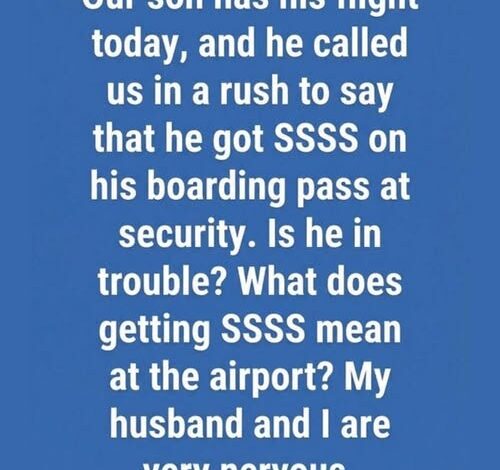
For most passengers, the process is predictable: check in, pass through security, wait at the gate, and board. But occasionally, a traveler glances at their boarding pass and notices four bold letters printed near their name: SSSS.
Those letters stand for Secondary Security Screening Selection, a designation used in the United States aviation security system.
While the code can cause confusion or concern, its meaning is specific and procedural. Understanding what it represents—and what it does not—can make the experience significantly less stressful.
What SSSS Actually Means
SSSS is an acronym for Secondary Security Screening Selection. It is used by the Transportation Security Administration (TSA), which operates under the U.S. Department of Homeland Security (DHS).
When these four letters appear on a boarding pass, it means the passenger has been selected for enhanced screening. This selection is generated through the Secure Flight program, a passenger prescreening system administered by the TSA.
Airlines transmit passenger information—such as full name, date of birth, and gender—to TSA before a flight. That information is compared against government watchlists and analyzed for risk indicators.
It is critical to clarify two common misconceptions:
- SSSS does not mean you are on the No Fly List.
Individuals on the No Fly List are not issued boarding passes at all. - SSSS does not automatically imply wrongdoing.
It does not mean you are under criminal investigation or suspected of a specific crime. It means that, for that particular flight, the system has selected you for additional screening.
In most cases, the designation is temporary and flight-specific.
When and Where SSSS Appears
The SSSS marking is most commonly seen on boarding passes for:
- International departures to or from the United States
- Flights originating in certain international airports
- One-way international itineraries
- Last-minute ticket purchases
Passengers flagged with SSSS often cannot use mobile boarding passes or self-print kiosks. Instead, they are required to check in at the airline counter so that an agent can verify identification documents in person.
This is one of the earliest indicators that enhanced screening will occur.
What Happens During Secondary Screening
If SSSS appears on your boarding pass, the standard airport routine changes. While regular security screening may take only a few minutes, secondary screening can extend your time at the checkpoint by 10 to 30 minutes or more.
The enhanced screening typically includes several components:
1. Comprehensive Pat-Down
A TSA officer conducts a more detailed physical screening than the standard metal detector or body scanner process. The pat-down is performed by an officer of the same gender and follows a structured protocol.
2. Explosive Trace Detection (ETD)
Officers may swab your hands, clothing, carry-on items, and sometimes personal electronics. These swabs are tested using equipment designed to detect microscopic traces of explosive materials. This process is routine and highly sensitive.
3. Full Carry-On Inspection
All items in your carry-on luggage may be removed and examined individually. Officers may:
- Flip through books and notebooks
- Inspect cosmetic or toiletry containers
- Examine the lining of bags
- Open and test electronic devices
4. Electronic Device Verification
You may be asked to power on electronic devices such as:
- Laptops
- Tablets
- Cameras
- Mobile phones
- External battery packs
If a device cannot power on, officers may conduct additional inspection. For this reason, it is wise to keep devices charged when traveling internationally.
Why You Might Be Selected
One of the most frustrating aspects of SSSS is the perceived unpredictability. The TSA does not publish detailed selection algorithms, but several known factors can contribute.
Random Selection
Aviation security relies on unpredictability. A certain percentage of passengers are selected at random to ensure that screening remains dynamic. This is a core component of layered defense strategies.
Random selection helps prevent patterns that could be exploited.
Travel Patterns
The Secure Flight system analyzes itinerary data. While perfectly legal, certain travel characteristics may trigger additional review:
- One-way international tickets
- Last-minute bookings
- Cash ticket purchases
- Travel to or from regions identified as higher risk
- Complex international itineraries
These factors do not imply wrongdoing. They simply align with historical risk models used in aviation security.
Name Similarity to Watchlists
One of the most common causes of repeated SSSS designations is name similarity. If your name and date of birth are similar to someone on a government watchlist, the system may have difficulty distinguishing between identities.
This issue can affect individuals with common names or names that resemble those of listed persons. In these cases, repeated enhanced screening may occur unless the traveler resolves the mismatch.
The DHS TRIP Redress Process
For travelers who experience recurring SSSS designations due to mistaken identity, the government provides a formal remedy through the DHS Traveler Redress Inquiry Program (DHS TRIP).
DHS TRIP allows individuals to submit documentation that helps clarify identity. The process may involve providing:
- Passport copies
- Birth certificates
- Government-issued identification
- Travel history information
If the review determines that the traveler has been misidentified, DHS may issue a Redress Control Number. This number can be entered when booking flights, allowing the Secure Flight system to differentiate the traveler from a person of concern.
While not an absolute guarantee, obtaining a Redress Control Number significantly reduces repeated SSSS occurrences caused by name confusion.
The Broader Security Philosophy
To understand why SSSS exists, it helps to consider the broader post-9/11 aviation security framework.
Modern aviation security operates on a layered defense strategy. No single safeguard—whether reinforced cockpit doors, air marshals, passenger screening, or intelligence analysis—is perfect on its own. Instead, security agencies combine multiple independent layers designed to overlap.
SSSS represents one of those layers.
It functions as an additional inspection mechanism designed to introduce unpredictability and depth into screening procedures. Even if a hypothetical threat bypassed one checkpoint, secondary screening increases the likelihood of detection.
Security experts sometimes refer to this approach as the “Swiss Cheese Model,” where multiple imperfect layers are stacked so their weaknesses do not align.
International Context
While SSSS is primarily associated with U.S. aviation security, similar enhanced screening procedures exist in other countries. Many international airports conduct additional screening for passengers traveling to the United States due to U.S. security requirements.
In some cases, enhanced screening may occur at the departure gate rather than the main security checkpoint. Gate agents may recheck boarding passes and conduct secondary bag inspections before boarding begins.
This is especially common on U.S.-bound international flights.
Practical Tips if You Receive SSSS
If you discover SSSS printed on your boarding pass, preparation is key.
Arrive Early
Plan to arrive at the airport at least one additional hour earlier than usual for international flights.
Remain Calm and Cooperative
TSA officers are following standardized procedures. Cooperation typically ensures the process moves as efficiently as possible.
Keep Electronics Charged
Ensure laptops, tablets, and phones can power on if requested.
Organize Carry-On Bags
Packing neatly can speed up inspections. Avoid overstuffed compartments that require prolonged sorting.
Monitor Connecting Flights
If you have a tight international connection, allow extra buffer time.
Privacy Considerations
Some travelers express concerns about privacy during enhanced screening. While the procedures are thorough, they are governed by federal regulations and oversight. Officers are trained to follow established protocols.
Passengers may request private screening rooms if preferred during pat-downs. TSA also provides channels for feedback and complaints if a traveler believes procedures were not properly followed.
How Often Does It Happen?
Exact percentages are not publicly disclosed, but most frequent flyers never encounter SSSS. Others may experience it once or twice over many years of travel.
For a small subset of travelers—usually those affected by name similarity issues—it may occur repeatedly until resolved through DHS TRIP.
What SSSS Is Not
To maintain accuracy and avoid misinformation, it is important to emphasize what SSSS does not represent:
- It is not a criminal charge.
- It is not confirmation of watchlist placement.
- It does not automatically indicate surveillance.
- It does not permanently affect future travel unless repeated issues remain unresolved.
In the vast majority of cases, it is a temporary screening designation tied to a specific flight.
The Human Side of Aviation Security
Air travel involves balancing efficiency with safety. Millions of passengers pass through U.S. airports daily. The Secure Flight system and secondary screening protocols are designed to manage that scale while minimizing risk.
From a traveler’s perspective, SSSS may feel inconvenient. From a security standpoint, it is one component of a comprehensive protective framework.
The aviation system depends on data science, intelligence gathering, and operational procedures working together. While most of that infrastructure remains invisible, SSSS is one of the few moments when passengers see evidence of it directly.
