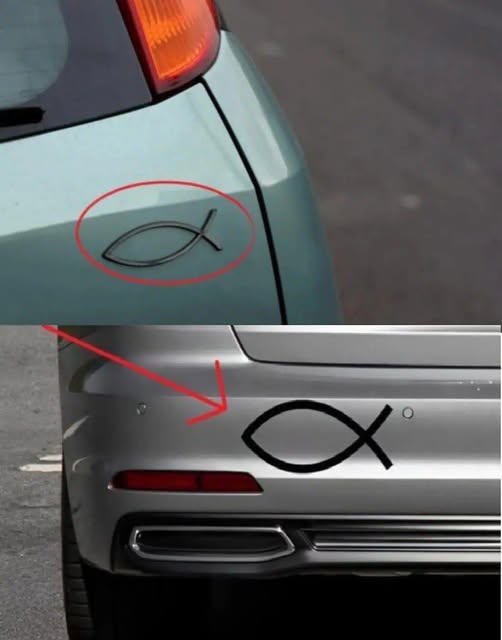
You may have noticed it while sitting at a red light, merging onto a busy highway, or inching forward in rush-hour traffic—a small silver fish affixed to the trunk or bumper of the car ahead.
It catches the glow of brake lights and reflects it softly, simple yet distinct against metal and glass. It is not large or dramatic. It does not flash or light up.
Still, it stands out just enough to stir curiosity. What does that small fish mean, and why do so many drivers choose to place it on their vehicles?
At first glance, the symbol can appear to be just another decoration, no different from a sports team decal or a vacation souvenir sticker.
Yet the fish emblem—often known as the “Ichthys” or “Jesus fish”—has a long and well-documented history rooted in early Christianity.
Its presence on modern cars is not random or accidental. For many people, it represents faith, identity, and a desire to carry personal values into everyday life, including the time spent behind the wheel.
The word “Ichthys” comes from the Greek word for fish (ἰχθύς). In early Christian tradition, the letters of this word formed an acronym for the phrase “Iēsous Christos Theou Yios Sōtēr,” which translates to “Jesus Christ, Son of God, Savior.”
This interpretation has been referenced in early Christian writings and historical studies of symbolism. During the first few centuries after the life of Jesus, Christians lived under the Roman Empire, and at various times they faced suspicion and persecution.
Open displays of faith could bring social or legal consequences. Because of this, believers sometimes used discreet symbols to identify one another.
The fish shape became one of those subtle identifiers. According to historical accounts and Christian tradition, a person might draw a simple curved line in the sand.
If another person completed the shape into a fish, it signaled shared belief. Whether every detail of this story can be proven in each instance is debated by historians, but the broader historical use of the fish symbol among early Christians is well supported by archaeological findings.
Fish imagery appears in ancient Christian art found in catacombs and on early Christian artifacts.
The connection between Christianity and fish symbolism is also rooted in the New Testament. Several passages in the Gospels describe fish and fishing in meaningful ways.
Some of Jesus’ earliest disciples were fishermen. In the Gospel accounts, Jesus calls them to become “fishers of men,” a metaphor for inviting others into faith.
There are also narratives describing the feeding of large crowds with loaves and fish, and stories of post-resurrection appearances involving shared meals of fish. These repeated references strengthened the association between fish imagery and Christian belief.
Over time, as Christianity spread and eventually became legally recognized within the Roman Empire, the need for secrecy diminished. The fish symbol did not disappear, however.
It continued as a meaningful emblem in Christian art and culture. In later centuries, the cross became the most widely recognized symbol of Christianity, but the fish remained a secondary yet enduring sign.
Fast-forward to the twentieth century, particularly in the United States, and the fish symbol experienced renewed popularity. With the growth of car culture and the increasing personalization of vehicles, people began expressing aspects of their identity on their cars.
The fish emblem, often made of chrome or silver plastic, became a common accessory. It is widely available in stores and online retailers that sell religious items. Its modern form is typically a simple outline of a fish, sometimes containing the word “Jesus” inside it.
For many drivers, placing the fish symbol on a vehicle is a personal declaration of Christian faith. It signals religious identity in a quiet and non-confrontational way. Unlike a large sign or slogan, the fish is understated. It does not require explanation for those who recognize it, and it does not demand attention from those who do not.
Importantly, the symbol itself does not promise protection, good fortune, or safety from accidents. There is no doctrinal teaching within mainstream Christianity that a fish emblem on a car guarantees divine protection.
Rather, it functions as a reminder—primarily to the person who chose to display it—of the values associated with their faith. Those values often include patience, kindness, humility, and respect for others.
Driving can test those virtues. Traffic congestion, unexpected delays, and moments of frustration are part of daily life for many commuters. In such an environment, a small symbol can serve as a subtle nudge.
For some drivers, seeing the fish on their own vehicle when approaching it in a parking lot is a reminder to act in a way consistent with their beliefs. It may encourage thoughtful behavior: allowing another car to merge, avoiding aggressive gestures, and practicing self-control in stressful situations.
At the same time, the fish emblem also communicates something to observers. It can foster a sense of recognition among fellow Christians who notice it. In areas where religious expression is common, the symbol may pass without comment. In more diverse settings, it may spark curiosity or respectful conversation.
In either case, it represents a personal choice rather than an institutional mandate. No central Christian authority requires believers to display the fish on their cars. Its use is voluntary and varies widely among individuals and denominations.
Over the years, variations of the fish symbol have emerged. Some include additional words, such as “Jesus,” placed inside the outline. Others incorporate design changes.
There have also been alternative designs created in cultural debates, including versions intended to reference evolutionary science. These variations reflect broader social conversations, but the original fish symbol remains associated historically and culturally with Christianity.
From a design perspective, the fish is simple and effective. Its clean lines make it easy to reproduce in metal, plastic, or vinyl. The silver or chrome finish commonly used on car emblems mirrors the finish of many vehicle logos, allowing it to blend aesthetically while still being noticeable. The minimalism of the shape contributes to its longevity; it has not required significant redesign over the centuries to remain recognizable.
Sociologists who study religious expression in public life often note that small symbols can serve as markers of identity without escalating conflict. The fish emblem fits into this category. It is visible but not loud. It invites interpretation rather than forcing it. For many drivers, it is less about persuading others and more about expressing who they are.
It is also worth noting that the fish symbol’s meaning can vary slightly depending on the individual. For some, it primarily represents belief in Jesus Christ as described in the New Testament.
For others, it reflects broader values such as compassion, forgiveness, and community involvement associated with their understanding of Christianity. The emblem itself does not enforce a specific theological position; it simply points to a shared religious heritage.
In practical terms, the fish on a car does not change traffic laws, road conditions, or the mechanical performance of a vehicle. Its impact is symbolic rather than functional.
Yet symbols have power precisely because they shape attitudes and intentions. A driver who consciously associates the fish with a commitment to patience may respond differently in tense moments than they otherwise would. While not measurable in a scientific sense, this psychological effect is real for many individuals.
The endurance of the fish symbol also speaks to the broader human tendency to carry personal beliefs into public spaces. Just as some people wear jewelry that reflects their faith or display meaningful objects in their homes, others choose to place small emblems on their vehicles.
Cars, after all, are extensions of daily life. They transport families, friends, and coworkers. They are present in moments of routine and in significant life events. Adding a symbol to a car can feel like integrating faith into the flow of ordinary existence.
In increasingly diverse societies, the presence of religious symbols in public spaces sometimes raises questions about coexistence. The fish emblem, however, typically exists within the bounds of personal expression.
It does not represent government endorsement or institutional authority. It is comparable to any other privately chosen decoration on a vehicle. Its meaning depends on the individual who displays it.
For observers who are unfamiliar with its history, learning about the fish symbol can provide insight into early Christian communities and the ways in which faith traditions adapt across time. What began as a discreet sign among believers in the Roman Empire has become a widely recognized emblem in contemporary culture. The journey from ancient sand drawings to chrome car accessories illustrates how symbols evolve while retaining core meaning.
Ultimately, the small silver fish on the back of a car is more than a decorative accessory, but it is also less than a magical charm.
It is a sign rooted in documented Christian history and scripture, revived in modern times as a voluntary expression of faith. For many drivers, it functions as a quiet reminder to align behavior with belief—especially in moments when patience is tested.
In the constant motion of modern roads, where anonymity can sometimes make people less considerate, even a modest symbol can encourage reflection. The fish does not force kindness, nor does it guarantee perfect conduct. It simply suggests an intention. It reflects a desire to carry values of respect and compassion into shared spaces, including highways and city streets.
So the next time you notice that small silver fish reflecting brake lights in front of you, you are seeing a symbol with centuries of history behind it. Its meaning has traveled from ancient Greek language and early Christian gatherings to contemporary traffic lanes.
It remains simple in shape yet rich in significance—a reminder that even in fast-moving, crowded places, many people still seek to express faith and live according to principles they hold dear.
