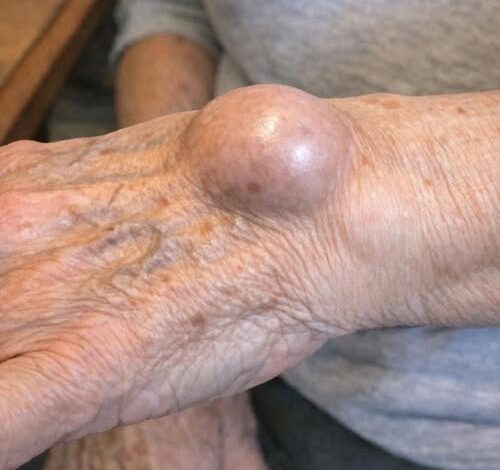
The sudden discovery of an unfamiliar lump on the body can be deeply unsettling. When that lump appears on the wrist—an area we rely on constantly for movemen.
Grip strength, and fine motor control—the concern can feel even more immediate. The wrist is not only visible but functionally essential, involved in nearly every daily activity from typing and driving to lifting and writing.
It is therefore completely natural for a person to feel anxious when a swelling seems to appear “overnight.” In today’s world, where health information is widely available online, it is easy to jump to worst-case conclusions.
However, clinical evidence consistently shows that most wrist lumps that develop quickly are benign (non-cancerous). One of the most common causes is a condition known as a ganglion cyst, which accounts for the majority of soft-tissue masses in the hand and wrist.
Understanding what a ganglion cyst is, how it forms, how it differs from other conditions, and when medical attention is necessary can help replace fear with informed decision-making.
Why Some Wrist Lumps Appear So Suddenly
When people say a lump appeared “overnight,” it usually does not mean it formed instantly. Instead, the structure may have been developing gradually beneath the surface before becoming visible or noticeable.
In the case of ganglion cysts, the rapid appearance is typically related to fluid movement rather than abnormal cell growth.
The wrist contains joints lined with a tissue called synovium. This lining produces synovial fluid, a thick, clear substance that lubricates joints and tendon sheaths, allowing smooth motion. A ganglion cyst forms when synovial fluid escapes from the joint capsule or tendon sheath and collects in a small sac. This can happen due to:
- Minor repetitive stress
- Joint irritation
- Previous injury (even if forgotten)
- Degeneration of connective tissue
The fluid accumulates in a balloon-like sac attached to the joint or tendon sheath by a narrow stalk. Once enough fluid collects, the lump becomes visible.
Because this is a fluid-based process, the lump can fluctuate in size. It may become more noticeable after heavy wrist activity and shrink during periods of rest.
What a Ganglion Cyst Typically Feels Like
Ganglion cysts most often appear on:
- The back (dorsal side) of the wrist
- The palm side (volar side) near the base of the thumb
- Occasionally along finger joints
They usually measure between 1 and 3 centimeters, though some remain smaller. To the touch, they may feel:
- Firm or rubbery
- Smooth and rounded
- Slightly movable under the skin
Unlike aggressive tumors, ganglion cysts are not fixed to deeper tissues in a rigid way. However, they are anchored to a joint capsule or tendon sheath, which prevents complete free movement.
Most ganglion cysts are painless. When discomfort does occur, it is often due to pressure on nearby nerves or joint structures. Symptoms may include:
- A dull ache
- Tingling
- Mild weakness
- Reduced range of motion
Importantly, ganglion cysts are benign and not cancerous. They do not spread to other parts of the body.
Who Is Most Likely to Develop One?
Ganglion cysts are most common in adults between ages 20 and 40. They occur more frequently in women than men. They are also seen in:
- Athletes who place repetitive stress on wrists (gymnasts, tennis players)
- Individuals who type extensively
- People with a history of wrist sprain or injury
However, they can occur in anyone, including adolescents and older adults.
Conditions That Can Mimic a Ganglion Cyst
Although ganglion cysts are the most common cause of a wrist lump, physicians must rule out other possibilities. Accurate diagnosis ensures appropriate treatment and peace of mind.
Lipomas
Lipomas are benign tumors composed of fatty tissue. They tend to be:
- Softer than cysts
- More freely movable
- Slower growing
They are usually painless and not connected to joints.
Giant Cell Tumor of the Tendon Sheath
Despite the word “tumor,” this condition is typically benign. It presents as:
- A firm, solid mass
- Non-translucent
- Slow-growing
- Often attached to tendon sheaths
It does not contain fluid and requires surgical removal if symptomatic.
Bone Spurs (Osteophytes)
These are bony projections associated with osteoarthritis. They:
- Feel hard and immovable
- Are part of the bone itself
- Often occur alongside joint stiffness
Rheumatoid Nodules
In people with rheumatoid arthritis, firm lumps may develop under the skin. These are usually:
- Located near pressure points
- Associated with systemic autoimmune disease
Infectious Abscess
An abscess differs significantly from a ganglion cyst. It is usually:
- Painful
- Warm to the touch
- Red
- Associated with fever
Abscesses require urgent treatment.
Warning Signs That Require Immediate Medical Attention
While most wrist lumps are not emergencies, certain symptoms require prompt evaluation:
- Rapid growth accompanied by severe pain
- Redness and warmth spreading around the area
- Fever
- Numbness in fingers
- Weak grip strength
- Difficulty extending or lifting the wrist
These signs may indicate nerve compression or infection. Early medical care can prevent complications.
How Doctors Diagnose Wrist Lumps
The diagnostic process typically begins with a physical exam. Physicians assess:
- Location
- Texture
- Mobility
- Pain response
- Effect on movement
One simple technique sometimes used is transillumination, where a light is shone through the lump. Fluid-filled cysts often glow slightly, while solid masses do not.
Imaging
If the diagnosis is uncertain, imaging may be recommended:
Ultrasound
- Non-invasive
- No radiation
- Differentiates fluid from solid masses
- Frequently first-line imaging
MRI (Magnetic Resonance Imaging)
- Provides detailed soft tissue visualization
- Useful if deeper structures are involved
- Helps rule out rare conditions
Aspiration
In some cases, a physician inserts a sterile needle into the lump to withdraw fluid. If thick, clear, jelly-like fluid is obtained, it confirms a ganglion cyst.
Treatment Options
Treatment depends on symptoms.
1. Observation (Watchful Waiting)
Many ganglion cysts resolve on their own without intervention. If the lump:
- Is not painful
- Does not limit motion
- Is not cosmetically concerning
A physician may recommend monitoring only.
2. Splinting
Temporary wrist immobilization may reduce fluid production and shrink the cyst.
3. Aspiration
Fluid removal can relieve pressure. However, recurrence rates are relatively high because the cyst wall remains attached to the joint.
Studies suggest recurrence after aspiration may occur in up to 50% of cases.
4. Surgical Removal
For persistent, painful, or recurrent cysts, surgical excision may be recommended. The procedure involves:
- Removing the cyst
- Removing part of the capsule or tendon sheath
Surgery is typically outpatient. Recovery includes:
- Temporary splinting
- Gradual return to activity
- Physical therapy if needed
Recurrence after surgery is lower than aspiration, estimated around 10–15%.
Why Home Remedies Are Not Recommended
Historically, some people attempted to burst wrist cysts by striking them with heavy objects. This method is unsafe and strongly discouraged. It can cause:
- Bone fractures
- Nerve injury
- Severe bruising
- Infection
Similarly, puncturing a cyst at home introduces serious infection risk.
Safe home management includes:
- Rest
- Ice application for swelling
- Over-the-counter anti-inflammatory medication (if appropriate)
- Wrist support
Psychological Impact of Sudden Physical Changes
A visible lump can trigger anxiety disproportionate to its medical seriousness. This reaction is normal. The hand and wrist are highly visible and closely associated with identity and function. Concerns about long-term damage, work ability, or serious disease can amplify stress.
Clear medical evaluation provides reassurance. In most cases, once a benign diagnosis is confirmed, anxiety decreases significantly.
Long-Term Outlook
The prognosis for ganglion cysts is excellent. They are non-cancerous and do not become malignant. Many resolve spontaneously. Others remain stable for years without causing problems.
Even when surgical removal is required, outcomes are typically very good, with full restoration of wrist function.
Preserving Wrist Health
Preventive measures include:
- Avoiding repetitive strain
- Taking breaks during typing or manual tasks
- Using ergonomic supports
- Strengthening wrist muscles
- Addressing joint pain early
While prevention is not always possible, joint care can reduce irritation.
Rare but Serious Causes
It is important to emphasize that malignant tumors in the wrist are extremely rare. When they occur, they often present differently:
- Irregular borders
- Rapid invasive growth
- Persistent worsening pain
- Systemic symptoms
Medical imaging and biopsy are used in rare uncertain cases.
Replacing Fear with Knowledge
The human body can change unexpectedly. A new lump may feel alarming, especially when it appears quickly. However, statistics and clinical experience consistently show that most wrist lumps—especially those appearing suddenly—are benign ganglion cysts.
Timely medical evaluation ensures correct diagnosis. Modern imaging provides clarity. Treatment options are effective and safe.
The goal is not only removal of a lump but preservation of hand function and peace of mind.
If you notice a wrist growth:
- Observe its size and symptoms
- Avoid self-treatment
- Schedule medical evaluation
- Seek urgent care if red flags appear
Knowledge transforms uncertainty into manageable action.
In the overwhelming majority of cases, a sudden wrist lump is not a life-threatening condition. With proper assessment and evidence-based care, patients can move forward confidently, knowing that their wrist health—and overall wellbeing—are well protected.
