The advancement of culinary arts over centuries has introduced an impressive range of kitchen tools and gadgets to everyday households.
From precision thermometers and stand mixers to food processors and air fryers, modern kitchens are filled with devices designed to save time, improve consistency, and expand creative possibilities.
Yet alongside these sleek innovations, antique kitchenware continues to hold a special place in the hearts of collectors, home cooks, and historians alike.
There is something deeply reassuring about holding a well-worn utensil that has passed through generations—an object that reflects both craftsmanship and cultural tradition.
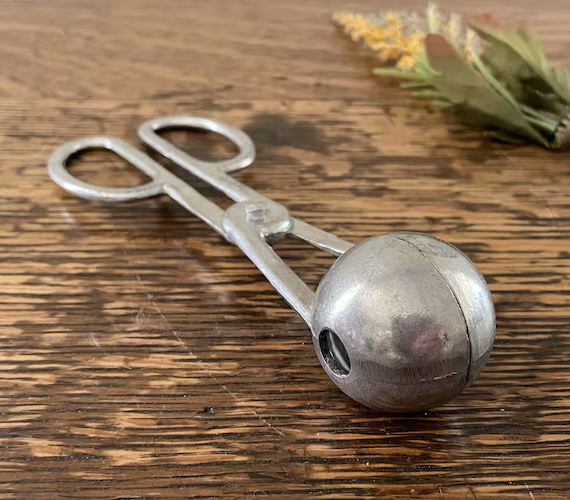
Among these nostalgic items is the retro meatball maker, a simple yet clever tool that once made shaping uniform meatballs easier in home kitchens. Many antique versions resemble hinged tongs or scoops with shallow, rounded cups designed to form evenly sized portions of ground meat.
Over time, their design evolved. Modern versions may resemble spring-loaded scoops similar to ice cream disher tools, while older models were often made of cast aluminum or steel with wooden handles. To someone unfamiliar with earlier designs, these tools may not even be immediately recognizable.
The enduring appeal of such gadgets is tied not only to their function but also to the culinary traditions they represent. Few foods are as globally recognized and culturally adaptable as the meatball.
Though often associated with Italian cuisine in popular culture, the concept of shaping ground meat into compact portions and cooking it in various ways appears across numerous civilizations and historical periods.
Food historians generally agree that meatballs, in some form, have existed for thousands of years. In ancient Rome, for example, cooks documented recipes that included finely chopped or ground meat combined with spices and other ingredients, then shaped and cooked.
The Roman cookbook traditionally attributed to Apicius, compiled in late antiquity, includes preparations that resemble early forms of meatballs. While it would be inaccurate to claim Rome as the sole origin, it is clear that Roman culinary practices included similar techniques.
Beyond Rome, evidence of meatball-like dishes appears in ancient China. Chinese culinary traditions feature lion’s head meatballs—large, tender pork meatballs often braised and served with vegetables.
Historical records indicate that variations of these dishes date back many centuries. In the Middle East, particularly in regions that were once part of the Persian Empire, dishes such as kofta developed.
The word “kofta” itself comes from a Persian term meaning “to pound” or “to grind,” reflecting the preparation method. Kofta recipes spread widely across Central Asia, the Middle East, South Asia, and parts of North Africa through trade and cultural exchange.
In Turkey, köfte remains a cornerstone of national cuisine, with dozens of regional variations. Some are grilled, others baked, and some simmered in sauces.
In Sweden, Swedish meatballs—known as köttbullar—became a defining comfort food, typically served with creamy sauce, lingonberry jam, and potatoes.
Though often perceived as uniquely Swedish, historians acknowledge that the recipe was influenced by culinary exchanges between Sweden and the Ottoman Empire in the 18th century.
The widespread presence of meatball-like dishes across cultures is not surprising. Grinding or finely chopping meat allowed cooks to make tougher cuts more tender and stretch limited resources.
Mixing meat with grains such as rice or breadcrumbs, or with legumes like lentils, increased volume and nutritional value. This technique was practical, economical, and adaptable to local ingredients.
In some traditions, meatballs were made primarily from beef or lamb. In others, pork, chicken, or even fish served as the base. The proportions of meat to filler varied depending on regional availability and economic conditions.
In ancient and medieval societies, combining meat with grains was common, not only for cost reasons but also for texture and flavor balance. Lentils, chickpeas, herbs, and spices were frequently incorporated, creating a wide range of tastes and consistencies.
Over time, meatballs evolved into both humble household fare and refined culinary creations. In Italy, polpette can be served alone as a main dish or incorporated into pasta.
Contrary to common belief, serving meatballs directly on spaghetti became more widespread in Italian-American cuisine than in traditional Italian cooking. In Italy, meatballs are often smaller and served separately or in soups.
The versatility of meatballs is one reason they have endured for centuries. They can be fried, baked, grilled, braised, or steamed. They may be simmered in tomato sauce, cooked in broth, glazed with sweet-and-sour sauces, or seasoned with aromatic spices. They can appear in sandwiches, tucked into pita bread, added to rice bowls, or served as appetizers.
From a culinary science perspective, the success of a meatball depends on balance. Ground meat contains proteins that bind when mixed and cooked properly. Gentle mixing prevents toughness, while adequate seasoning enhances flavor.
Eggs and breadcrumbs often act as binders, helping the mixture retain moisture and structure. Cooking method also matters. Frying creates a browned crust through the Maillard reaction, enhancing flavor complexity. Braising in sauce can keep meatballs moist and tender.
The development of specialized kitchen tools, such as meatball makers, reflects the importance of consistency in cooking. Uniform size ensures even cooking, preventing some pieces from becoming dry while others remain undercooked.
In professional kitchens, consistency is essential for both presentation and food safety. In home kitchens, tools that simplify repetitive tasks help cooks prepare larger quantities efficiently.
Antique meatball makers, like many vintage kitchen tools, were designed with durability in mind. Cast metals, sturdy hinges, and mechanical simplicity allowed them to withstand years of use. Unlike many modern plastic gadgets, these older tools often remain functional decades later. Collectors value them not only for their practicality but also for their aesthetic qualities—engraved handles, polished metal surfaces, and the patina that develops with age.
The nostalgia associated with antique kitchenware often extends beyond the objects themselves. These tools evoke memories of family meals, handwritten recipes, and traditions passed from one generation to the next. In many households, recipes for meatballs are closely guarded family heirlooms, adjusted slightly over time but rooted in shared history.
Modern culinary innovation has not replaced these traditions; rather, it has expanded upon them. Today, plant-based meatballs made from legumes, grains, and vegetable proteins offer alternatives for vegetarian and vegan diets.
Advances in food technology have enabled meat substitutes that mimic the texture and flavor of traditional ground meat. While these products differ from historical versions, they reflect the same fundamental idea: shaping a protein-rich mixture into small portions that can be cooked and enjoyed in countless ways.
Globally, meatballs continue to serve as cultural ambassadors. In North Africa, spiced meatballs may be simmered in tomato sauce with eggs, forming dishes such as kefta tagine. In South Asia, kofta curry features meatballs cooked in aromatic gravies infused with turmeric, cumin, coriander, and other spices. In East Asia, fish balls are commonly served in soups and street food dishes. Each version reflects regional ingredients and culinary techniques.
The enduring popularity of meatballs also lies in their adaptability to different meals. They can be served as a standalone entrée accompanied by vegetables or grains. They can enhance pasta dishes by adding protein and texture. They can enrich soups with heartiness. They can be layered into sandwiches or wraps for convenient meals. Their compact shape makes them suitable for buffets and gatherings.
Nutritionally, meatballs can vary widely depending on ingredients and preparation. Lean meats, moderate use of binders, and baking instead of frying can create lighter options. Incorporating vegetables into the mixture can increase fiber and micronutrient content. As with many foods, balance and portion control are key.
The story of meatballs is ultimately a story of human creativity and adaptation. Across continents and centuries, cooks discovered that grinding meat, combining it with available ingredients, and shaping it into manageable portions provided both nourishment and satisfaction. Trade routes, migration, and cultural exchange spread variations of the dish worldwide.
Antique tools like retro meatball makers serve as tangible reminders of that shared history. Though modern kitchens may rely on advanced appliances, the fundamental techniques remain similar. Shaping, seasoning, and cooking with care continue to define good food preparation.
In an era when culinary trends change rapidly, meatballs remain remarkably consistent. They are comforting yet versatile, traditional yet adaptable. Whether served in a rustic home kitchen or a contemporary restaurant, they connect diners to a long lineage of cooks who valued flavor, efficiency, and resourcefulness.
The advancement of kitchen technology has certainly transformed how meals are prepared, but it has not diminished the charm of traditional methods. Antique utensils, including vintage meatball makers, remind us that innovation often builds upon foundations laid generations earlier.
Today, whether formed by hand, shaped with a modern scoop, or crafted using a vintage press, meatballs continue to bring people together at tables around the world. They are a testament to culinary continuity—a simple concept refined across time, cultures, and kitchens.
In that sense, the humble meatball represents more than just a dish. It embodies the enduring intersection of practicality, tradition, and creativity that defines the culinary arts.
